Cursive Sentences
Once single letters and words are comfortable, sentences train spacing, rhythm and capitals. Pangrams are the best drills: each one uses every letter of the alphabet.
Pangrams: every letter in one sentence
Uses all 26 letters
Uses all 26 letters
Uses all 26 letters
Uses all 26 letters
Everyday sentences
Sentence tracing worksheet
Two pangrams and one everyday sentence, each with a model row and a trace row. For your own sentences, use the worksheet maker.
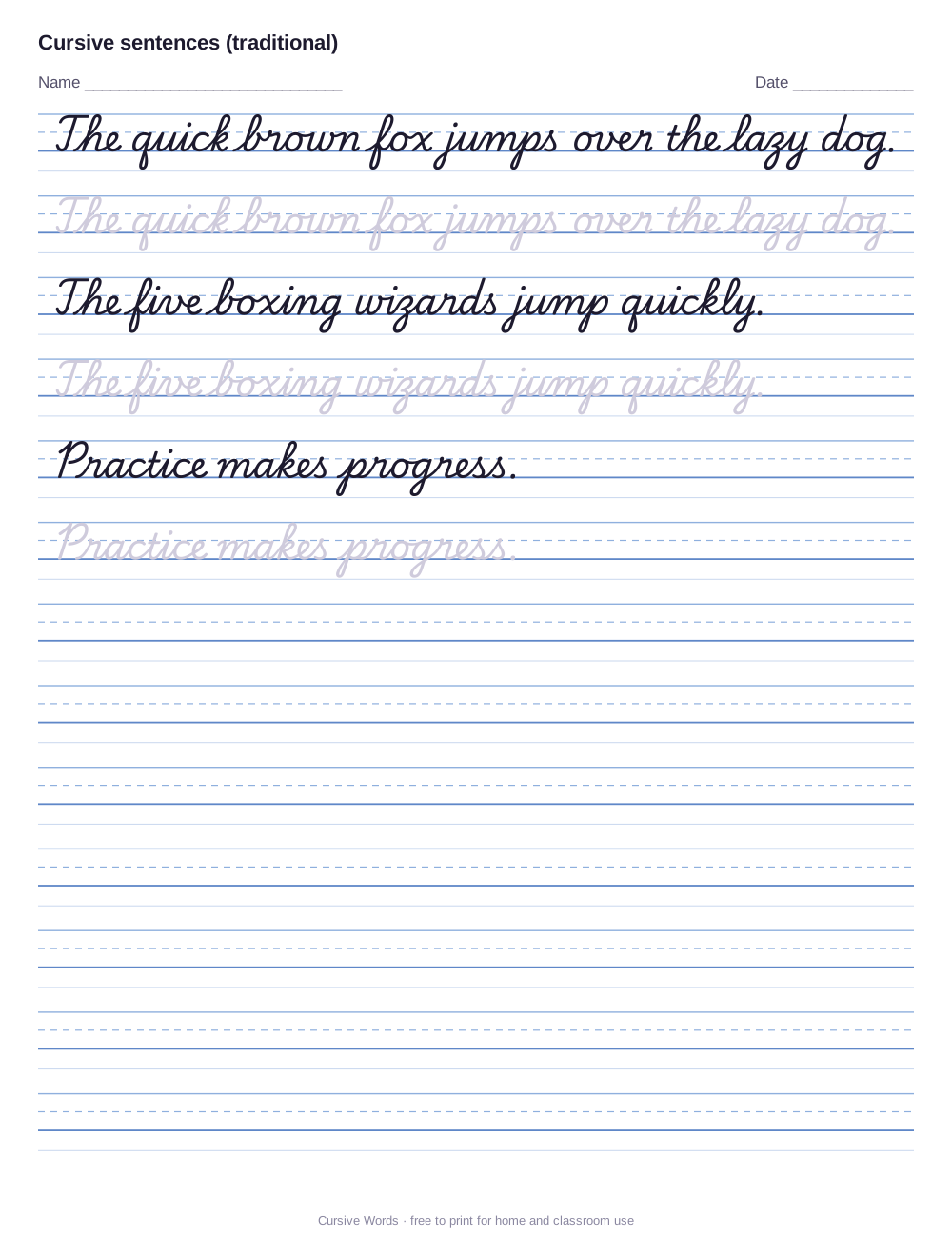
Choose “Save as PDF” in the print dialog to keep a copy. Trace the light rows, then write on your own in the empty rows.
Tips for writing sentences in cursive
- Join every letter inside a word, then lift the pencil between words. Leave about the width of a lowercase o between them.
- Keep the slant the same across the whole line; uneven slant is the most visible sign of rushed cursive.
- Write punctuation after the word, without joining it.
- Capital letters that don't join (B, D, F, G, H, O, P, S, T, V and W) need a small lift before the second letter.
Brush up on single words first in words in cursive, or on individual letters in the cursive alphabet.
Questions
What is a good sentence to practise cursive?
“The quick brown fox jumps over the lazy dog” uses every letter, so one line works through the whole alphabet. Shorter pangrams like “The five boxing wizards jump quickly” are good for faster drills.
Should I join words together in cursive?
No. Letters inside a word are joined; words are separated by a small space and a pencil lift.